Showing posts with label Physics. Show all posts

Saturday, September 29

This Little Light of Mine

Ok. Now we'll get to that question that you had a while ago, which is: but what if I'm designing my own solar system and can adjust the eccentricity of the orbit and the tilt of the planet however I want? Well, then we can get a bit more funky. There are essentially two parameters we can change here: the relative sizes of the two effects and the offset between them. First, let's line up the two effects as they currently exist to instead of partly cancelling each other out, they build on each other. It's not very impressive, and life would remain basically the same for us; we get a little more sun in the summer, and a little less in the winter.


Next, we'll leave them out of phase as they are for us, but make them about the same size. Specifically, I've made it so when we're far from the sun, we get only half the sunlight we would at the near point. Instead of the max and min distance differing by only 3%, now they differ by 41%. This one makes life pretty weird. The folks in Fairbanks never get much sun now, and nobody gets much in the middle of summer when we're far from the sun. People in Utah or Michigan type zones get the most consistant light through the year, while the equator now has 4 seasons. (In this situation we might need to crank up the temperature knob on the sun to keep us all from freezing, but that might be difficult. In the real life system the 5 locations recieve 340, 311, 269, 244, and 142 artibrary units of sunlight over the course of a year. Now they get 263, 234, 199, 178 and 96. If we turn up the sun to get St George back up to where it was, those points shift to 356, 316, 240 and 130. We've kept St. George reasonable (well, as reasonable as it ever was), but made the equator 5% more sunny, while Fairbanks is still 8% less sunny than before. Essentially, this world is more sunlight-diverse.)


Next, we'll make them roughly the same magnitude, but with a 90° phase shift (one curve peaks 3 months before the other). Specifically, we hit the near point of our highly elliptical orbit about April 1st, with the tilt unchanged. This gets a little crazier. The total sunlight is not as low as the last model (263, 241, 209, 190, 111, which "St. George Adjusts" to 338, 310, 269, 244 and 143.) So, if we crank up the sun about 30%, we get the same total sunlight through the year. Unfortunately, it's going to be packed into a few really bright (hot) months. The equator has more seasonal variation than before, but is dominated by the position in the orbit, not the direction of the tilt. Also, everyone now has seasons!


Finally, what if we leave the orbit how it is, but tilt the earth over more . . . 45° sounds good. Well, Fairbanks now doesn't get sunlight for 100 days a year. Michigan gets the sun directly overhead in the summer now, but the sun barely makes it over the horizon in the winter. (Insert joke about how "it barely makes it over the horizon in the winter as it is" here.) The most interesting thing though, is that we've nearly introduced seasons to the equator. The total variation is something similar to what a place like Hawaii has on our earth (I know, doesn't really qualify as seasons) but the interesting thing is that they get 2 complete sets each year. More sun in March and September, with less in December and June. Really, that's how it is now (go back and look at the graph) but this would make the effect about 3.5 times bigger, so it would probably be noticable. If we roll the earth over further and push the angle to about 55°, then the equator gets double St. George like seasons, but gives even St. George 33 days without sunlight each year (and 67 for Michigan) so I'm voting against that one.

So, in the end, the earth is neat.
(It is a worthwhile reminder that there are still other things that are important to sunlight that I haven't considered. The most important is the dispersion through the atmosphere. As the sunlight moves closer to the horizon, it has to go through more of the atmosphere to reach the surface, and more light is scattered out. Then there are things like clouds to consider. Also, while this sunlight is the cause of our seasons, there are many other things that effect temperatures, such as residual ground heat, ocean and air currents and butterflies flapping their wings in China.)

Friday, September 28

Here Comes the Sun

The days are getting shorter (at least for all my northern hemisphere readers) these days. And they're doing it quickly. Which means it is time to talk about . . . . math! This blog post has already been split into at least three, so get pull out your slide rules and compasses . . . .

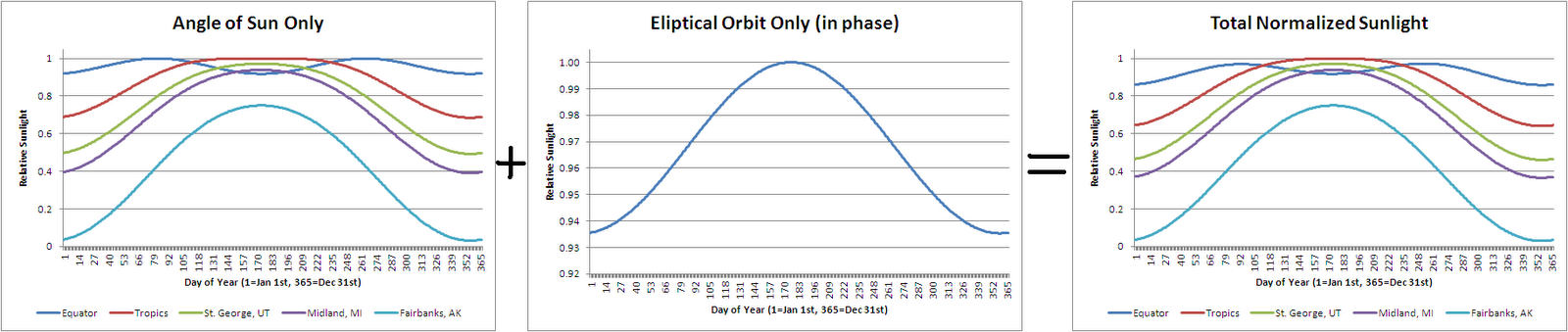
Most people know that the Earth orbits the Sun in an eliptical orbit. However, in our efforts to get everyone to appeciate that the orbit is eliptical, the eccentricity (oval-ness) of the orbit is always greatly exaggerated in diagrams in textbooks. The difference between the aphelion (furthest point from the sun) and the perihelion (nearest point) is over 3 million miles, but that's only a 3.3% total variation. Imagine going out in a field, and walking in an oval around someone standing in the center. At the furthest point you're 100 feet away from the other person, and at the nearest point you're only 97 feet away. The difference is going to be almost completely unnoticable. But somewhere along the line, we decided that it was important that everyone know that the orbit is eliptical, so we really stress that point. Now, a 3% increase in distance does mean that we get less light from the sun when further away, and the effect is increased because when you move double the distance from a light source you only get a quarter the light. So the 3.3% distance variation turns into a 6.5% maximum variation throughout the year. Here's a picture:

You should note (and perhaps be surprised at) one detail of the graph, which isn't really visible because of where the year cuts off: we are closest to the Sun on about January 3rd, and furthest from the sun around July 3rd. For those of us in the northern hemisphere this is probably a good thing. During winter, we get to scooch 3% closer to the warm sun to compensate for the fact that we're angled away from the sun due to the tilt of the earth.

Oh! Hey! What about the earth-tilting-thing? Well, yeah, that's obviously important, because it's clear that our seasons aren't coming from the ecentricity of our orbit. ("But," you say, "what if . . " and then I cut you off right there and reply, "Quiet, we'll get there in a minute. I have more charts first.") The rotational axis of the earth is about 23.4° off of normal (perpendicular) to the plane of our orbit. This is the number that also defines the lattitude of the tropics of Cancer and Capricorn. (By the way, they're moving towards the equator a few hundred feet each year, currently. The tilt has been varies from about 22.5° to 25.2° every 40,000 years.) So, if the magnitude of your lattitude is less than 23.4°, then at some point in the year, the sun will be directly overhead. If not, you've always got to look towards the equator to find the sun. (From here on out, everything I mention will be specifically talking about when the sun is at its highest point each day.

If the sun is directly over head, the sunlight is as concentrated as it can be on the surface of the earth. Imagine going outside while the sun is directly overhead and make sure to bring with you a sheet of stiff paper. If you hold the paper out horizontally, it will cast a shadow and, provided the light source is very far away (I think the sun qualifies), the shadow will be the same size as the paper. The shadow is the area of light that the paper is blocking, and can be thought of as how much light is striking the paper. Now slowly rotate the paper away from horizontal. The shadow shrinks. Less total light strikes the paper, but that light is still spread out over the entire sheet. As the paper approaches vertical, the light on the paper gets dimmer and dimmer. For someone tiny microbe living on that paper this means two things: less light and less heat. All we have to do now is replace the paper with the earth, replace the microbes with people, and that describes our seasons. So, we all know from practicle experience that at different times of the year we get more or less sunlight, and that this is also dependent on where we live on the globe. Here's a picture that shows the amount of sunlight the earth receives throughout the year at different lattitudes:

I've picked 5 different lattitudes to show here. For someone at the equator, the sun is sometimes a bit off to the north, and sometimes a bit off to the south. Someone directly on the Tropic of Cancer line will see the sun directly overhead on the day of the solstace for maximum sunlight in June, with less in the winter. The next two locations, St. George (37.1° N) and Midland (43.6° N), have some personal significance to me. The final line I picked was Fairbanks, AK (64.8° N), which is about as far north as you can go before you get any days without a sunrise. (That line would be 66.6° N (or S) which is 90° - 23.4°.) You can sort of visually fill in a line inbetween the ones I have drawn for where you live, based on your lattitude. Once you are out of the tropics, the graphs looks basically the same, with a peak in the middle (summer) and a low spot on the edges (winter). You can see that Midland gets 5-10% less sunlight than St. George at any time in the year with this model. The variance between the seasons also increases as we head towards the poles. St. George ranges from 0.49 to 0.97 (compared to a value of 1.00 when the sun is directly overhead), while Fairbanks ranges from 0.03 to 0.75.


Well, now we've finally reached the question that I had when I started on this journey. (Yes, I was bored and had a question in my head that prompted me to make up a spreadsheet modeling the orbit and tilt of the earth around the sun. What's your point?) To what extent do these two factors constructively (or destructively) interact to influence the amount of sunlight we receive? The answer, as you can see from the vertical scales on the graphs is that the tilt of the earth is vastly more significant than the distance from the sun. In a sense, 23.4° >> 0.0167 (Earth's eccentricity). The next graph is the product of the first two, which looks, pretty much like the previous one. The two curves are pretty well out of phase, with one hitting a max around June 21st, and the other around January 3rd.

Now I know that you're all curious about the locigal next step, which is to ask questions about what if the orbit was more elliptical, or the earth was tilted more or tilted less. Well, we'll save that for the next post, but if you've got anything you specifically you want to see, let me know and I can cook it up!

Friday, June 29

Physics 105 Problems in Real Life

I spent many years helping physics 105 students work problems about someone throwing a ball off a hill with some sort of initial velocity where they have to figure out what the time of flight is, or the final distance or something like that.  A common comment is that no one does this in real life.  I've said it myself many times.

This week at work, we had something break.  It sits up fairly high off the floor, and threw some broken pieces across the room.  The details aren't important, but this was a bit of a safety hazard, as things aren't supposed to fly across the room.  As part of the report on what happened, they wanted to come up with an estimate of how fast the pieces were moving across the room, as a gauge of how dangerous the event really was.  So they came to me.  Finally, my skills are fully utilized!  With a few simple formulas I was able to calculate the initial velocity of the objects based on their final location, initial height and initial angle.  Sure, the calculation isn't perfect.  I can only guess a reasonable range of angles (though, because of other things in the room, and, you know, the ceiling, I can do pretty good on that) and we're neglecting friction (as always!), but the point is, I was finally able to use those very basic equations for motion in two dimensions to solve a real problem at work!

Tuesday, October 27

Elements

I saw an interesting blog today where someone (an organic chemist) had counted how many different elements he had worked with. Now, a lot of the ensuing discussion can depend on how you define "working" with an element. I'm having trouble putting a specific definition into words, but let's just say that I know it when I see it. In general, the element in question needs to have been a deliberate and important part of what was going on. So, here's what I've used, and, if I feel like it, what I've done.

1: Hydrogen - I've collected H2 gas off of a reaction using HCl, and also ignited H2-filled soap bubbles.
2: Helium - Does inhaling it from balloons count? Even if it didn't, I've put it through a diffraction grating and looked at it spectral lines. That one experiment from physics 107/150 is going to get me a whole handful of these.
3: Carbon - A whole semester of organic chemistry lab. Ewwww.
4: Nitrogen - Liquid nitrogen, for everything from shattering pennies, to making ice cream, to hammering rubber hoses into a 2x4, to actual productive purposes.
5: Oxygen - I've collected it out of the atmosphere as a liquid. Liquid O2 is very exciting. (And potentially very dangerous. I've never had more than a few mL of it.)
6: Fluorine - I use HF at work all the time. The first on this list that I haven't encountered in elemental form.
7: Sodium - It burns yellow. (Like the sun.) I've only burned it in solution though. Elemental sodium is quite dangerous.
8: Magnesium - Burns extremely bright white. It's what they use in fireworks, and it's fun to play around with strips of it. As a side note, water catalyzes it's oxidation, so be very careful how you fight a magnesium fire.
9: Aluminum - Drinking a can of Coke does not fill this requirement. But writing a senior thesis about microscopy of aluminum oxide does.
10: Silicon - More microscopy. And hours spent wedging it down until it is 0.000004 inches thick.
11: Phosphorus, 12: Sulfur, 13: Chlorine: As it turns out, a mixture of these 3 elements (as H3PO4, H2SO4 and HCl) will put holes in your pants quite nicely. Not quite the experiment that I was supposed to be doing, but it's the one that I remember.
14: Argon - this is what we use for an inert atmosphere at work.
15: Calcium - I've dissolved calcium carbonate in acid. Sounds exciting, but it's just limestone.
16: Iron - Well, who hasn't done something with iron?
17: Cobalt - The aluminum oxide I mentioned earlier, well, it was covered in cobalt.
18: Copper - Pennies aren't just for spending, they're also good to turn into brass.
19: Zinc - You take the old penny, disolve some zinc in acid, and, um . . . I forget the rest of the lab, but it ends up with a brass penny.
20: Gallium - it melts near room temperature, so it makes a nice phase transition lab for pre-med students. It also super cools pretty well, unless the surface of your sample is too oxidized, then it just won't re-solidify. And I use it at work all the time.
21: Germanium - I know thee well.
22: Zirconium - Used a strip of it as a heating element once upon a time. It had just the right resistivity.
23: Molybdenum - Hard to spell, and boring to measure the resistivity of a wire made of it! By this point in the periodic table, I'm now skipping the majority of the elements.
24: Indium - I've soldered with it to make electrical contacts.
25: Tin - Also used in soldering.
26: Cesium - I've measured the half-life of a radio active isotope.
27: Tungsten - My wedding ring is made of tungsten carbide. It doesn't scratch. I've tried. Yeah, it's a bit weak, but I'm counting this one.
28: Silver - I have deposited a film of silver onto glass to make my own mirror, which was then used in an experiment to measure the speed of light through different mediums. The experiement was a big failure, but it wasn't the mirror's fault.
29: Mercury - I've studied the spectral lines.
30: Lead - I've measured the half-thickness for stopping the radiation from the aforementioned Cesium isotope.

And, from here on out, pretty much everything is radioactive. There is one other radioactive isotope that I have worked with, but I can't remember what it was. Possibly it was a repeat, but I don't think it was. So, at this point, I can point to 30 elements I've used. There's probably another 1-3 that I have used, but I'm not remembering it at the moment.

Monday, April 27

More books

I hadn't realized how far behind I'd gotten on my books.

Brisingr:  This book follows Eragon and Eldest, which I read recently.  I read those two (which I had read before) to remember what happened, so I could read the third and final book in the series and be done with it all.  But, as it turns out, this wasn't the final book as I had thought.  It was long and entertaining as the others were, and, I was glad to see that it provided some plot twists that I didn't see coming.  I remain curious to see how it all turns out.  Sometimes it is best to discover series' after they've all been written so you don't have to do the annoying part of waiting for the next book.

Six Easy Pieces by Richard Feynman:  In 35 years at Caltech, Feynmann was listed as teacher of record for 34 courses.  25 were graduate courses.  I guess when you're as big a name as Feynman, you can teach what whatever you want (or not teach, as the case may be).  But for two years, he taught a series of introductory physics courses.  The lectures were recorded and eventually edited and published as Feynman's Lectures on Physics.  The finished work is famous, among physicists at least, and anyone out there is welcome to buy it for me.  (It's 3 volumes, and not cheap.)  Until that day, I have 6 Easy Pieces, which are exerpts from the lectures.  They're interesting and are Feynman's attempts to collapse some big topics, like "Basic Physics" into a single lecture.

Wednesday, March 25

The Fix

Chad Orzel has a great idea on how to fix the economic mess we're stuck in: Physicists Can Fix This.

You should read the whole post, it's not that long. But this is the gist presented in Q/A format, with me providing the questions, and Dr. Orzel responding:

Q: What's your plan?
A: "fire them. All of them. Every trader who bought or sold a mortgage-backed security, every manager who signed off on the buying and selling of credit default swaps, every CEO of every company now in need of a federal bailout, everybody who ever shook hands with Bernie Madoff."

Q: And who should we hire to run things?
A: "I've thought of the perfect replacements: physicists."

Q: But won't physicists screw it up because they don't know about business and economics?
A: "the people who are pushing that line the hardest are the people who stand to benefit most from large windfall payments to the current financial industry. Which is to say, the people who have wrecked the economy by failing to understand the most basic facts of the underlying market. They have lots of experience, to be sure, but the bulk of their experience is in being wrong about everything. They lost billions to a Ponzi scheme, for God's sake. And, seriously, do you really think that these transactions are too complicated for physicists to figure out? We're talking about people who have spent the last several years thinking about folding and twisting strings in eleven dimensions."

Thursday, September 11

Physics Man to the Rescue

So, the internet has been a flutter with stuff about the LHC (Large Hadron Collider) which was fired up for the first time yesterday in Switzerland. Specifically Ben has wondered if this could lead to the end of the world, (not an idea he made up) and Carrie has thought that it may be effecting my pens. I don't really know much about the LHC, or tiny black holes, but I suppose I know more about it than a lot of people, so I might as well comment.

First off, particle accelerators and colliders have been around for decades. A problem we have with atoms and other tiny things is that we can't look inside them. We can't disassemble them; there aren't screwdrivers small enough. So instead, to look inside an atom you smash something into it, bust it into all it's consituents and take a look at those as they come flying out. Then you try to guess what was going on before all the destruction. Its the equivalent of trying to figure out how a VCR works by dropping one off a tall building and examining the rubble. Or maybe it would be more like dropping a VCR off a cliff onto a rocky beach where the remains are only there long enough for you to take a few pictures before the waves take the parts away. All you have to look at are some photos of what was inside. With both particles and VCRs, the harder you smash, the more the little parts inside come flying out and the better idea you get of what was inside. Dropping your VCR from the top of your bed isn't likely to be very informative.

Hadrons are things made of quarks. Quarks are the things that make up Hadrons (and tend bar on DS9). Seriously, that's the only definition for hadrons and quarks that will mean anything unless you take a handful of physics classes (which will in turn offer only slightly more knowledge on the topic, little of which is useful for this discussion). Hadrons which you are most familiar with would be Protons, Neutrons and perhaps Mesons. Typically in colliders it is the Protons that are accelerated, because they aren't virtually impossible to push (like Neutrons) and they have a lifespan of greater than a billionth of a second (unlike Mesons).

So, the LHC is a gazillion dollar contraption to get those protons moving just a little bit faster than colliders in the past, to hopefully get a little more information about what protons are made of, and stuff like that.

Now a question and answer session between me and me:
Q: So, will any cool discoveries come from all the money spent on the LHC?
A: If by 'cool discoveries' you mean something potentially useful to the average person, then No. If by 'cool discoveries' you mean something potentially useful at all, then No. If by 'cool discoveries' you mean something in any way useful to anyone, or anything even remotely intelligible to anyone without a Ph.D. in physics, then the answer would still be No. This is not the space program bringing us plastics, microwaves, cool pens and tang. This is particle physicists trying to understand how subatomic particles work. It will not affect your life at all. (Of course, I could always be wrong, but I bet I'm not.)

Q: So why did we (humanity in general) spend all this money?
A: The same reason we put up the Hubble Telescope, we study handedness patterns in polar bears, and we have sociologists. I guess we're curious, or at least willing to help pay for others' curiosity.

Q: So what about these black holes coming to destroy the earth?
A: Not gonna happen. Again, I could be wrong, but it won't. I haven't reviewed my Hawking books lately, but current theories for how everything works allows for the existance of tiny, tiny black holes. How tiny? They would have pretty much an infinately small event horizon. And they would have a super tiny mass (much smaller than the mass of a dust particle). So, there remains a possibility that these super tiny black holes could be created by the LHC. If they are, because of their tiny size, they could actually fly all over the place without even colliding with anything. Also, black holes evaporate. Big black holes could take billions of years to evaporate, but small ones go much quicker. So, these tiny black holes should be disappearing almost immediately even if they are created.

In summary, a tiny black hole, which may be possible (but may not) could potentially be formed which would be unlikely to hit anything, or to last for much time at all. Basically, I'm not worried.

One final point: Yes, the turned on the LHC the other day, but they didn't even collide anything yet. If anything causing the end of the world were to happen I would think that the actual collisions would be causing it, but of course the media won't be covering that which isn't likely to happen for a few weeks.

Thursday, June 19

Quick math . . . long post.

Back of the envelope calculations are wonderful things.

Anyone who's ever taken physics has worked their way through ugly, messy calculations and has probably stressed out (way more than necessary) about how many decimal places to report on an answer. But sometimes, you don't need specific answers, you just want to have an idea of what an answer would be like. What would it cost to fill your swimming pool with jello? How many french fries have I eaten in my life time? You know, life's important questions. And so, we have back-of-the-envelope calculations. You don't need to do a study or make measurements, you just want the fun answer. Well, start making guesses and see what comes out! And, the neat thing is, if you're good, you can actually get pretty darn close to the 'right' answer that would take 10 times as long.

Do you want to fill up a room with balloons (probably for some girl's birthday or something)? How many balloons do you need? Well, let's say your inflated balloon is round (always assume spherical!) and 10" across. But I sense an upcoming difficulty in dealing with feet and inches, so let's call it a 12" balloon. That's 0.5' in diameter. So it's volume is 4/3*Pi*r^3 = oh, wait that's hard math. So, we'll call Pi=3, so it is now 4*r^3, or 4*.5*.5*.5 = 2*.5*.5 = 1 * .5 = 0.5 ft^3 per balloon. Ok, now how big is your room? Well, I don't know who's birthday you are planning for, but let's say you decide the room is 15' x 16'. Again, hard math, so let's rearrange the room in our heads to 12' x 20'. That's probably close to the same size. Now how deep do you want to fill your room? To fully immerse a person, you'll need about 6' of balloons. So 12' x 20' x 6' = 240 x 6 which is about the same thing as 250 x 6 (which is easier to do) = 1500 ft^3. If each balloon is half a square foot, you'll need 3000 balloons. That's a lot of balloons!

But we've got to think about our problem just a bit more. Two things jump out in my mind. First, the balloons don't all pack together nicely. They're roundish after all. So what percentage of the room is really going to be full of balloons, and what is going to be gaps between the balloons. Well, I'm just going to pull a number out of the air and say . . . 70% balloons. So we don't need to fill 1500 ft^3, only 70% of that. Secondly, what about all the stuff in the room already? That's a lot of balloons worth of space! Of the bottom 6 feet of the room, how much is full of stuff? Not tons. There is a lot of air. But still, the bed and desk and electric guitar might count for 20%. So we have to fill 80% of our 1500 ft^3 with balloons, but then only 70% of that space is actually balloon space (as opposed to air). So . . 1500 x 0.8 x 0.7 = . . . well, now you might just need a calculator, but you've got one on your phone . . . 1500 x 0.8 x 0.7 = 840 ft^3. Double that to get your 1680 balloons. There you go. Start blowing them up!

Now, obviously, we guessed at a lot of stuff. But, we're actually probably not that far off. We made a good half dozen guesses or simplifications, and it is likely that some of them made us over estimate the number of balloons, while others causes us to under estimate the number. Happily, the errors that we didn't even know we were making help to cancel each other out much of the time. (Though sometimes we might accidentally choose estimates that are all either too high or too low.) Even if we're too high by 30%, you'd still need 1000 balloons to pull off what you're trying to do. So you might want to rethink your plans. If you only go for 3 feet deep, you can do it for more like 500 balloons. Yeah, that sounds like a good plan.

Now, let me just warn you from experience that getting all the balloons to stay in the room is a big problem, and it turns out that if you're in a dry place your balloons will start to build up static charges as you pile them in the room which can get high enough that they actually start popping. And if you've been working on blowing up hundreds of balloons, the last thing you want to hear is them popping.

Now, this has gone on for quite a while. But we can see that in a few minutes, we can take our balloon-bedroom-surprise through a quick calculation and see just how feasible it might be. We could continue by doing a quick cost analysis for 1000+ balloons, as well as time estimates for how many man hours it will take to blow them all up.

These calculations take a bit of a talent for making reasonable estimates of things that you've probably never measured (your friend's room, the size of a balloon, the time to blow it up) but I maintain that this is an excellent skill to have.

Finally, a little assignment for you to do. (Even though I know you probably won't.) (Except maybe Brett.) Assuming there is 33x10^6 km^3 of ice between the antarctic and greenland sheets, how much would the ocean levels rise if they all melted? See what sort of answer you can get without looking up any other values. I did it guestimate style as well as with looking up real values and my two answers were less than 4% different. (And they're not much further off the "official" values that someone told me at work today.)

Wednesday, April 16

Perfectly Reasonable Deviations

Another book is finished. This time it is "Perfectly Reasonable Deviations from the Beaten Track: The Letters of Richard P. Feynman". Yes, I've gone somewhat Feynman crazy lately. Since Feynman himself published all sorts of accounts from his life of funny stories, you'd think reading letters he wrote would be pretty bland. But for the most part, the book was quite interesting. To me, at least. Being from a much earlier generation, Feynman wrote letters, not 13 word text messages, which his daughter has read through and condensed to a scant 416 pages. Feynman is the American physicist of the middle of the 20th century. In the continuum of notable physicists he occupies the space between Einstein and Hawking. And he'd completely hate that I just wrote that. He routinely asked to not be described as a Nobel prize winner, not out of disrespect for the prize, but because he didn't like the way everyone's reaction to him changed because of the prize. He learned to draw later in life, and refused to sell work to anyone who was looking for a drawing from a notable physicist; he would only sell his work to people who liked it for what it was.

Feynman lived in the middle of all the big events in physics in the middle of the 20th century. As a winner of the Einstein award, he was contacted for his opinion about a potential recipient of the award: Stephen Hawking. At a conference, he was talking to another physicist when a young man came up and asked the other physicist what he thought of his new theory to describe super-conduction. Feynman says he didn't understand any of it, but that the other guy was impressed. His letter on the subject just comments "Could this have been Cooper?" Um, as in "Cooper pairs" Cooper? It's a nerdy book. But me and Feynman, we're nerdy guys.

Friday, March 14

Pi day!

Today is Pi day (3-14)! Also, it is Einsteins birthday. For people like Shannon, this means we'll be eating pie, one of her favorite foods. But for the nerds, this fantastic intersection of events has led the nerds of the world to declare today Talk Like a Physicist Day. So today is the day to bust out all those words and phrases you've been neglecting for the rest of the year.
  • Use "orthogonal" to refer to things that are mutually-exclusive or can't coincide. "We keep playing phone tag -- I think our schedules must be orthogonal"
  • "About" becomes "to a first-order approximation"
  • A situation isn't "bad," it's "sub-optimal."
  • "Finite" can mean either "really big, but not infinite," or "really small, but not zero."
  • Something that moves from one state to another slowly-- say, a highway driver who takes a mile and a half to move from one lane into the other-- does so "adiabatically."
  • Difficult problems are "nontrivial."
Here are more suggestions of those weren't enough.

Tuesday, March 11

Everyone thinks I am a nerd. And I'm ok with that. Because I am a nerd. But there is one entity out there that actually over-estimates my nerditude. Amazon.com insists that I am actually the biggest nerd imaginable. Whenever I go there, it has suggestions for what I should buy. I divided the 15 books into 5 basic categories:
  • Quantum Mechanics Textbooks, 2
  • Math Textbooks, 3
  • Thermal Physics/Thermodynamics Textbooks, 4
  • Classical Mechanics Textbooks, 2
  • Other Physics Textbooks, 4
Apparently the only thing I've ever purchased from Amazon is physics textbooks, so it naturally assumes that I must want 15 more. Let this be a reminder to everyone about the false picture of reality that we can develop when we only have 3 or 4 data points.

Wednesday, February 27

Bad Blogger

I've been a bad blogger lately. There's no good excuse other than being busy, and unable to remember what it was I wanted to blog once I finally get to a computer.

I've wanted to blog this from home (and you'll see why) but my birthday was 2 weeks ago, and I got some nerd books. A left-hander one from Suzanne, Mormon Scientist (?) which is a book about Henry Eyring, written by Henry J Eyring, and a book of Richard Feynman's letters. I've started reading the book on lefties. Obviously I'll provide a more thorough review, as well as the actual title of the books once I've finished them.

I haven't disappeared from the internet, though. Ben has been asking questions about nuclear fission and fusion, which I've been attempting to answer. Not that you probably care, but there it is. Of course, if you've recently taken a class on nuclear engineering, you're likely to find an error in my comments, but I believe them to be generally accurate, and I was trying to keep things relatively short.

Finally, it's always amusing to see what little kids are saying.

Sunday, December 23

Why you can't learn physics

I believe that, more so than most branches of science, people have problems with physics. I see it every time I tell people I have a degree in physics when they ooh and aah at my clearly superior intellect. For some reason, the world seems to believe that physics is Hard. I don't fully understand this, but while I was browsing at Barnes and Noble I found a book that demonstrates an interesting point.

A series of books are available at your local book store (unless you live in St. George where all book stores suck) titled "[Science] Demystified". I saw "Physics Demystified" as well as "Biology Demystified" and "Calculus Demystified" today. I fully support the idea that any of these topics can baffling. What concerned me, however, was something that was written on the cover of "Physics Demystified". It's one of those things like "474 full color images" or whatever they say to convince you that the book will be easy to understand and interesting. Their most important selling point that they wanted to get across to the world about their book was: "LOTS of illustrations to relate PHYSICS to the REAL WORLD".

And that, right there, is why people don't understand physics. Because they don't know what physics even is. It would be like making "Auto Repair Demystified" and claiming that it has "LOTS of illustrations to relate AUTO REPAIR to FIXING CARS". Physics is nothing more than a quantitative description of the real world. You don't need to relate it to the real world. It is the real world. Physics is about describing how things happen. You throw a ball up, it comes back down. (Unless you can throw it up at 11km/s.) Can anyone tell me how throwing a ball up relates to real life?

Monday, September 17

Un-book review

I like to review books I've read. And I haven't done that for a while. So I'd like to review the book which is to blame. The Road to Reality: A Complete Guide to the Laws of the Universe by Roger Penrose.

Now, if you're like me, you're thinking that there's no conceivable way to write such a book, because anything that could possibly be considered a "complete guide to the laws of the universe" would have to be about 1,000 pages long. As it turns out, it's 1,136. Yes, one thousand one hundred thirty-six pages. And it's not light reading. So after about 200 pages, I had to give up, because it's boring. Nerd books that I like to read have a few inherent problems.

First, they all feel the need to start with a discussion of math, and to go back to the beginning of math. As a result, I've got at least half a dozen books that all start with the very same first two chapters. One is on Pythagoras and mathematical proof, the other is on Euclid.
The next chapter then catches us up on other important mathematicians, such as Euler (rhymes with 'boiler') and Gauss and Godel.

The second problem the nerd books have relates to the level of information. In physics, there are 4 levels of mastery of material, which directly correspond to physics course work. First, you read about it or hear about it. You've read it, so you feel like you know it. But you don't. Second, you work the problems. Certainly you know it now, because you've done the math! These two levels are reached by introductory classes, which could be taken in high school, or early on in college. But it turns out that you never really understand it just because you did the math. You don't really understand it until you derive it. Some of those derivations happen in the advanced undergraduate courses, while others wait for graduate school. Once you can derive something for yourself, you really feel like you've mastered it. But you haven't. Each of these three levels can be moved up one notch by the last step, which is teaching the previous step. Then you've really learned it. Teaching people to work the problems puts you on the same level (roughly) as doing the derivations. And teaching the derivations is something that is generally left to graduate students and then professors.

Anyway, back the to book. The problem with nerd books is that they're usually stuck at level 1: talking about it. Because no one wants to do homework for a book they're reading in their spare time. Except Roger Penrose doesn't know that. So he has homework problems in his book. So to really get everything out of his book, you'd have to read it at the kitchen table with pencil and paper in hand. And it turns out, I don't want to. I want to read a book at 11pm as I'm laying in bed.

So once I'd reached chapters about 'hypercomplex numbers' and 'calculus on manifolds' I knew I was done. Penrose is just going too deep for what I want, particularly considering he's still got 800 pages of stuff building on the hypercomplex numbers and the calculus on manifolds.

Thursday, April 5

Oustanding Teaching Assistant Awards

A year ago, or perhaps more, I was named an Outstanding Teaching Assistant for 2006. I won a free years membership to AAPT (American Association of Physics Teachers) and a year of Physics Today. This was back in March(ish) of last year, when I was a student still. Keep that in mind. It's important.

So, upon Googling me yesterday, Shannon found that the number one site is the AAPT site listing me as one of these outstanding TAs. There's about 125 people listed, and I'm one of them. Just don't look for me under BYU. Because I'm not there. Apparently, I attend a school known as "Sylarus Technologies". Yeah, somehow they got their signals crossed and they think my job is a school. If nothing else, maybe this gives Clair the power to give me an advanced degree or something.

It probably happened because I filled out some survey about what I'm doing now, and someone got my school and my job mixed up. It's funny, because I didn't even get this job until 6 months after I won the award. So if they had done their reporting in a timely fashion, they couldn't have possibly made such a mistake.

Saturday, March 17

You can take the nerd out of the physics class . . .

We went hiking on Saturday (I'm sure Shannon will provide the details you're interested in) but my favorite part of the hike was the water skeeters. You've probably all seen them scoot across the surface of the water, and you've possibly also heard the physics lecture about surface tension, but that isn't the neat part. The tiny weight of the bug doesn't break the surface of the water, but it does depress it, making tiny little depressions in the surface of the otherwise smooth water. But now there is a curved air/water interface, and it acts like a lens! The light from the sun is bent away by the curved water surface and as a result, each leg casts a huge shadow on the bottom of the pool.In the picture, you can see the eight shadows from the eight legs. The long small legs are the ones it uses to paddle around. Most of it's weight is on the legs that bend the water the most, which cast the largest shadow.

But where does the light go then? Well, a tiny amount of it hits the water at just the right angle to be reflected back, which you can see in the picture. But most of the light is sent to the edge of the dark shadow which is noticeably brighter in the picture. Hooray physics!

Friday, March 2

Nerd Dump

For some reason, I've just got a ton of things to say today. (And since I never get around to posting on the weekends . . .)

I never knew they were so nerdy, but apparently Conan O'Brien and Jim Carrey like to get together to discuss quantum physics. Because I know you're concerned about it, they do seem to be discussing good physics, though I question the phrasing used by Mr. Carrey in one part. He says that the phase of the electron can "either have the two values separated by π". I don't think you even have to be a physicist to wonder about that one.

Also, I got a most excellent email from Ben full of things that people have put on math/physics tests when they're frustrated, or have simply given up. Two selections are placed below for your viewing pleasure.

Tuesday, February 13

Where was this when I was a kid?

I was never much of a Boy Scout. I blame it on an inherent difference between my fundamental nature and The Boy Scouts of America. (no, I'm not gay, it's a different inherent incongruity.) I should have joined the "Order of the Science Scouts of Exemplary Repute and Above Average Physique". The OOTSSOERAAAP is like the scouts in that it gives out badges, but it's much more science-y, so I actually qualify for some of them. I'm most proud of my qualification for:

The "
I'm pretty confident around an open flame" badge,
The "my degree inadvertently makes me competent in fixing household appliances" badge,
The "has frozen stuff just to see what happens" badge (LEVEL III),
The "experienced with electrical shock" badge (LEVEL III)

Thursday, February 8

Albert, Invariants, Lester and Cats

Einstein once wrote a book that explained relativity for anyone with a high school education. He believed that even if you couldn't do all the math required, there wasn't anything stopping anyone from understanding relativity. I picked up the book at roughly that point in life and didn't find it terribly easy to understand. He used words I knew, but that doesn't mean I understood what he was getting it. (Of course, I have a degree in Physics, and got a near perfect score on my E&M final that was almost exclusively about relativity, so maybe I'm just relativity handicapped.) Anyway, it seems that Einstein was always trying to explain science to the common man. Just look at this Einstein quote which I have stolen blatantly from Tyler:

You see, wire telegraph is a kind of a very, very long cat. You pull his tail in New York and his head is meowing in Los Angeles. Do you understand this? And radio operates exactly the same way: you send signals here, they receive them there. The only difference is that there is no cat."

Tuesday, January 16

How to Avoid Frost

I've never liked having to scrape my car off in the morning, and I've discovered something interesting about it's formation in the last couple of days. Both Monday and Tuesday morning I have left for work when it was about 20°F, and neither day have I had to scrape my car off. Perhaps it's a weird coincidence that despite the cold, both days I've escaped scraping, or it has to do with the fact that I've left at 5 in the morning both days. Whenever it is that frost forms, it isn't before 5am. It must then be forming from 5 to 8am? I'd run more tests, but it's terrible to get up this early.

Another frost note. We stayed at the Anderson's this last weekend, and because Kim had one Civic in Provo, we got to park in the garage. Their garage is unattached to their house, unheated, uninsulated and cold. But even with nighttime lows around 6°F, no ice forms on the car windows. How does the car know that it's indoors? Also, what constitutes "indoors"? What if the garage door is left open? Apparently you don't get ice on the windows from just cold weather. It's got to be cold, outdoors and at the crack of dawn.